Shop Safety

Industrial Warning Signs

Warm-Up Game

Guess the Sign

Every sign on the next screen is a real symbol you could find on a factory floor, in a lab, or in our own shop. Before the answer appears, call out what you think the sign is warning you about, and what you'd do in response.

  1. 1
    Look at the shape and color first. They carry meaning before you ever see the picture inside.
  2. 2
    Guess the specific hazard or instruction the sign is communicating.
  3. 3
    Reveal the answer by clicking anywhere on the sign.
  4. 4
    Next moves to a new sign. There are 16 in all.
There is no penalty for a wrong guess here. The goal is to notice how much information a well-designed sign gives you in under a second.
Guess the Sign

What does this sign mean? Click to reveal.

The Code Behind the Picture

Shape and Color Speak First

Every sign you just guessed follows the international ISO 7010 system. Before you read the pictogram inside, the outline and background color already tell you what kind of message you're looking at, which is exactly why a worker can react to a sign from across a noisy shop floor.

Red Circle, Diagonal Bar

Prohibition. An action that is forbidden in this area.

Yellow Triangle

Warning. A hazard that requires caution or extra awareness.

Blue Circle

Mandatory. A specific protective action you must take.

Green Square

Safe condition. Exits, first aid, and rescue equipment.

Red Square

Fire equipment, such as extinguishers, alarms, and hose reels.
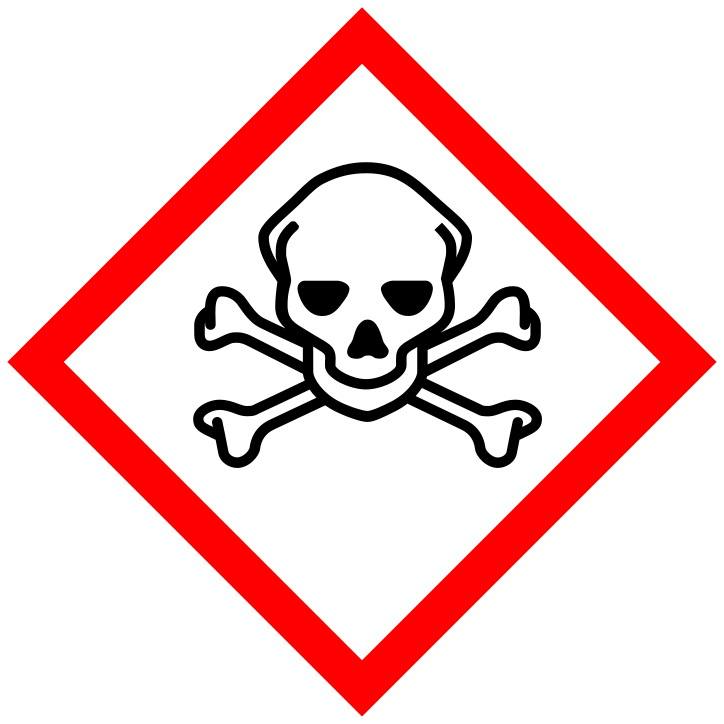
GHS toxic pictogram: skull and crossbones on a white diamond with a red border

White Diamond, Red Border

GHS chemical hazard. A separate global system, used on containers rather than on walls or equipment.

American Standard · ANSI Z535 / OSHA 1910.145

When the Sign Uses Words Instead

American shops often pair a pictogram with a text signal panel. The header color tells you how severe the hazard is before you finish reading the sentence underneath.

DANGER
An immediate hazard that will cause death or serious injury if not avoided.
WARNING
A hazard that could cause death or serious injury.
CAUTION
A hazard that could cause minor or moderate injury.
NOTICE
Important information that isn't a personal-injury hazard, like a maintenance policy.
Quick Reference · 1 of 2

Prohibition, Mandatory & Safe-Condition Signs

Quick Reference · 2 of 2

Warning, Chemical & Fire Signs

Why It Matters

Don't Let It Become Wallpaper

Safety researchers call it sign blindness: a warning stops working the moment it blends into the wallpaper. A sign you walk past every day still needs to register the instant it matters, whether that's the first day you touch a new machine or the one day something goes wrong.

Before you run any machine in this shop for the first time, find its signs. When you use the machine again, look at the signs. Know which ones are prohibitions, which are mandatory, and which mark the nearest safe exit or first aid station. That five-second habit is what the signs are actually for.

Second Activity

Choose the Warning

Now flip it around. Instead of naming a sign, you'll be given a station in the shop and a full bank of every sign you've seen today. Decide which ones belong there.

  1. 1
    Read the short description of the station or task.
  2. 2
    Select every sign in the bank you'd expect to see posted there. Pick as many as apply, a station can have more than one.
  3. 3
    Check your answer to see what you got right, what you missed, and what didn't belong.
  4. 4
    Next moves to a new station.
Don't select every sign "just to be safe."
Remember: Too many signs become wallpaper.
Choose the Warning
Station

Next Up

Industrial Warning Signs Safety Plan

Now put it in writing. Open the Industrial Warning Signs Safety Plan assignment in Buzz and apply what you practiced today to a real station in our shop.

  1. 1
    Open the Industrial Warning Signs Safety Plan assignment in Buzz.
  2. 2
    Pick a real station or machine in our shop, the same way you did in Choose the Warning.
  3. 3
    Document every sign it needs, and explain in your own words what each one protects against.
Follow the instructions in Buzz for what to submit and how it will be graded.