Parallel Circuits
- Components connect across the same two nodes
- Each branch receives the same voltage
- Current can split into multiple paths
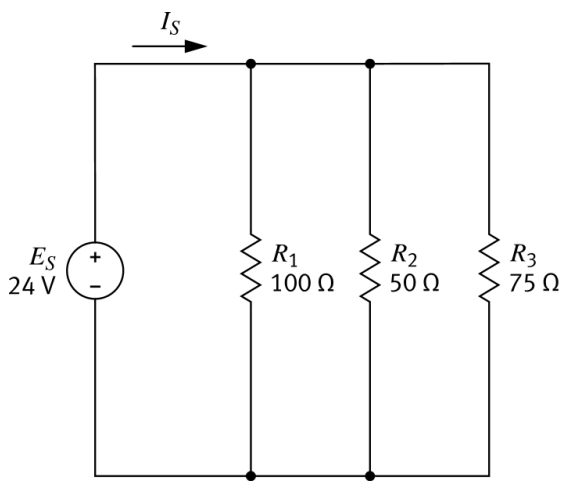
Resistance in Parallel
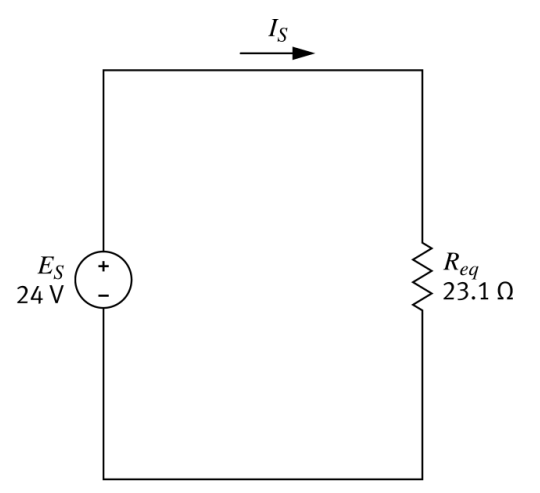
// Simplified Equivalent
1Req = 1R₁ + 1R₂ + 1R₃ + …
1Req = 1100 + 150 + 175
1Req = 0.010 + 0.020 + 0.013 = 0.043
Req = 10.043 = 23.1 Ω
Voltage in Parallel
- Voltage across every branch equals the source voltage
- All parallel components share the same potential difference
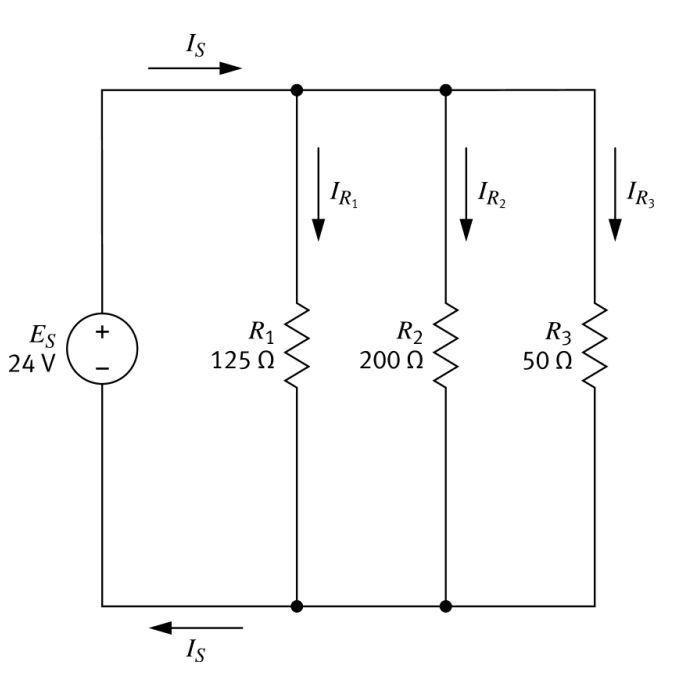
Current in Parallel
- Current divides between branches
- Branch current depends on resistance
- Lower resistance branch carries more current
Kirchhoff's Current Law
- Total current entering a junction equals total current leaving
- Total current = sum of branch currents
- Think of a fork in a river: water coming out equals water going in, even if one channel is narrower

Solving Branch Currents with Ohm’s Law
Ohm's Law
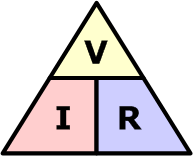
I = VR
The same source voltage (24 V) applies to every branch. Use Ohm's Law to find each branch current.
R₁ = 125 Ω :
IR₁ = ESR₁
= 24125 = 0.192 A
R₂ = 200 Ω :
IR₂ = ESR₂
= 24200 = 0.120 A
R₃ = 50 Ω :
IR₃ = ESR₃
= 2450 = 0.480 A
From Given Circuit to Source Current
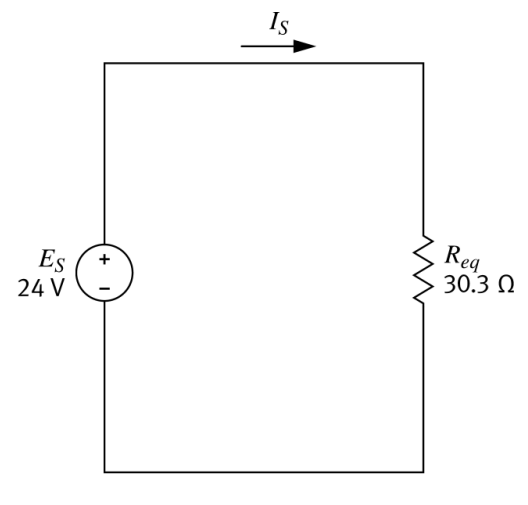
Ohm's Law
I = VR
Total Current IS
1Req = 1R₁ + 1R₂ + 1R₃
1Req = 1125 + 1200 + 150
1Req = 0.008 + 0.005 + 0.020 = 0.033
Req = 10.033 = 30.3 Ω
Calculate IS using Ohm’s Law and Req.
IS = ESReq
= 2430.3 = 0.792 A
KCL Check
IR₁ + IR₂ + IR₃ = IS
0.192 + 0.120 + 0.480 = 0.792 A ✓
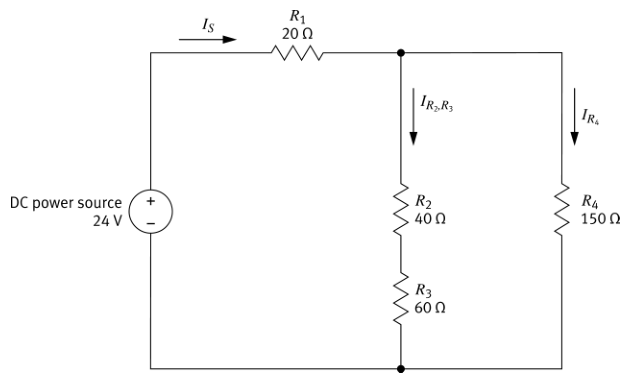
Mixed Circuits
- Contain both series and parallel connections
- Must be simplified step by step
1. Find & replace series resistor groups
2. Find & replace parallel resistor groups
3. Repeat until one Req remains
4. Calculate IS via Ohm's Law
5. Work backwards to find branch V and I
1
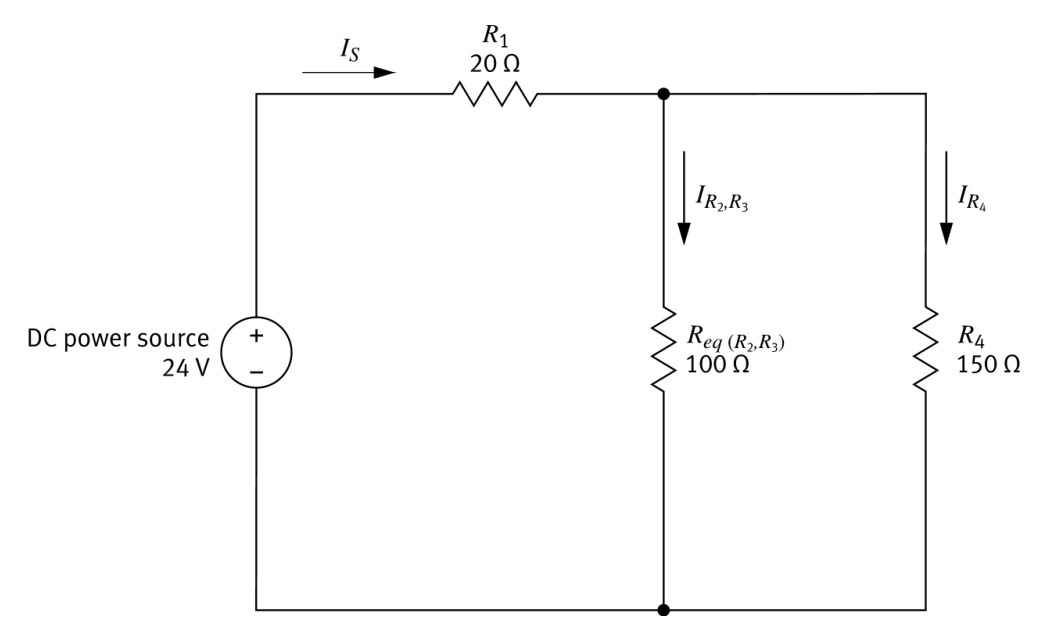
Identify & Replace Series Resistors
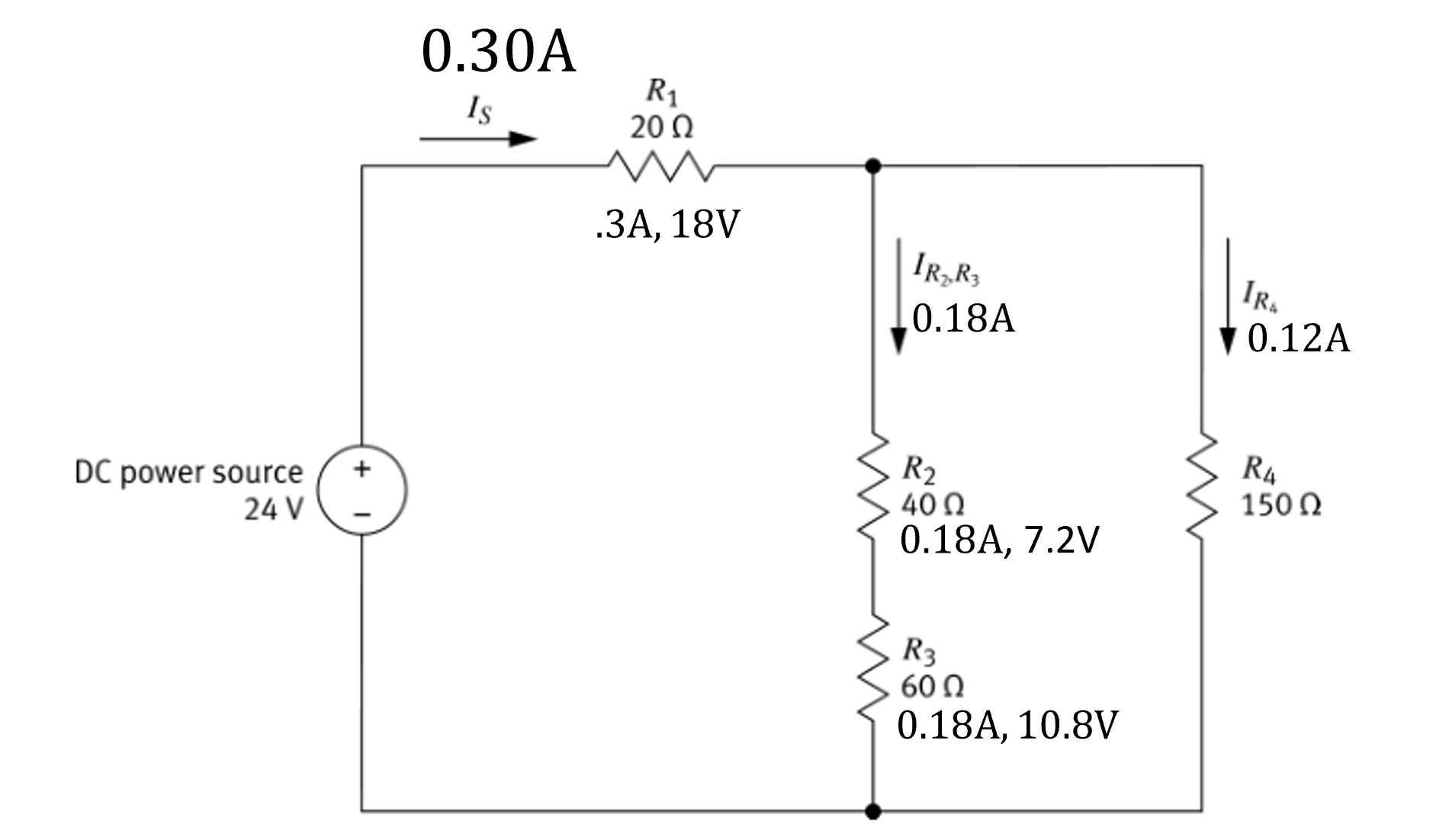
Original Circuit
R₂ and R₃ are in series.
Combine them:
Req = R₂ + R₃
Req = 40 + 60
Req = 100 Ω
After Step 1
2
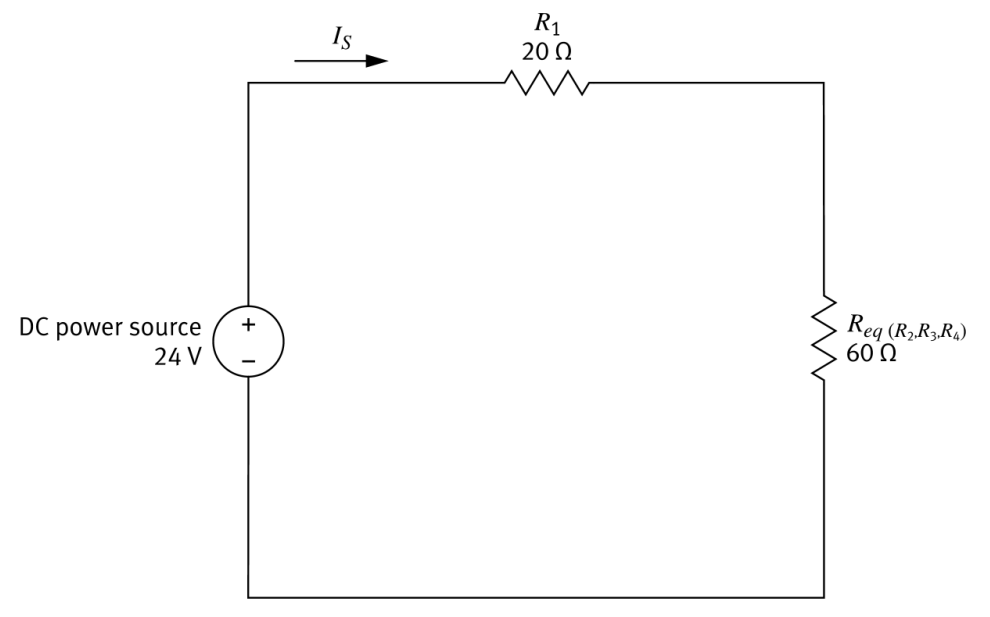
Identify & Replace Parallel Resistors
After Step 1
Req(R2,R3) = 100Ω and R₄ = 150Ω are in parallel.
Combine them:
1Req = 1R₁ + 1R₂ + …
1Req = 1100 + 1150
1Req = 0.010 + 0.0067 = 0.0167
Req = 10.0167 = 60 Ω
After Step 2
3
Continue Simplifying
After Step 2
R₁ and Req(R2,R3,R4) are in series.
Combine them:
Req = R₁ + Req(R2,R3,R4)
Req = 20 + 60
Req = 80 Ω
Fully Simplified
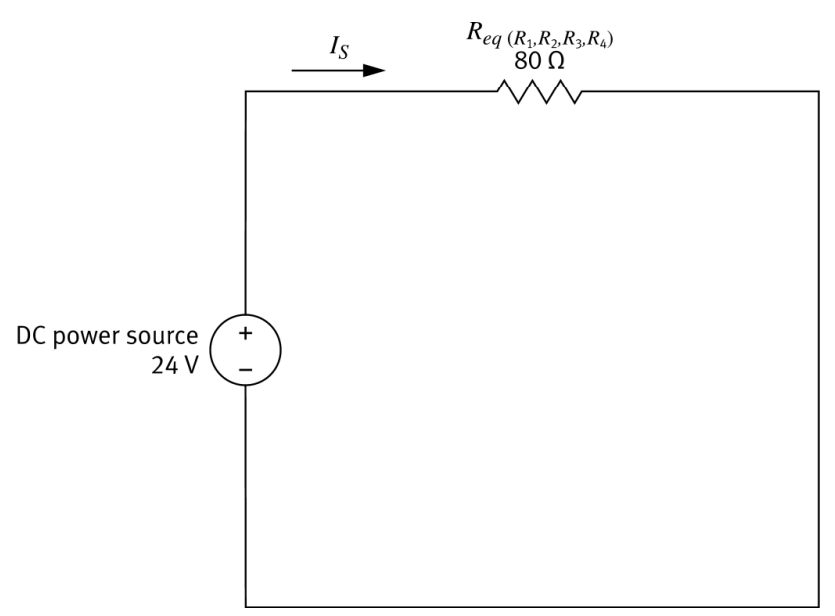
Now Work Backwards
- Start from the equivalent circuit to find total current.
- Use that current to recover branch voltages and currents.
- Continue step-by-step until each resistor value is accounted for.
4
Calculate Total Current IS
Ohm's Law
I = VR
IS = ESReq
= 2480 = 0.30 A
Total Source Current
IS = 0.30 A
5
Work Backwards — Voltage Drops
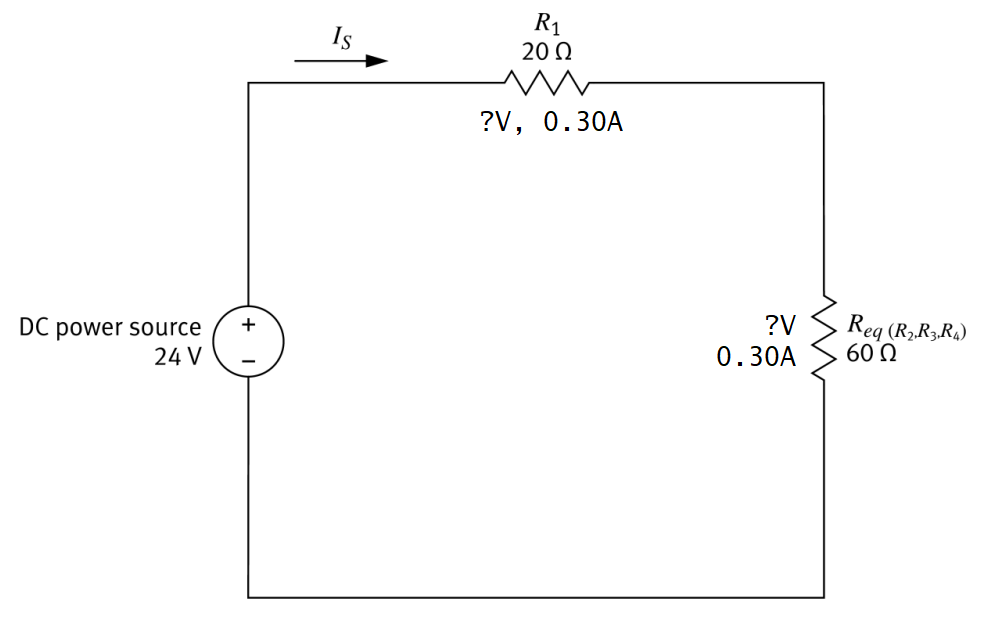
Ohm's Law
V = I × R
R₁ = 20 Ω :
ER₁ = IS × R₁
ER₁ = 0.30 × 20
ER₁ = 6 V
Req = 60 Ω :
EReq = IS × Req
EReq = 0.30 × 60
EReq = 18 V
KVL Check
18 + 6 = 24 V ✓
5
Parallel Branch Currents
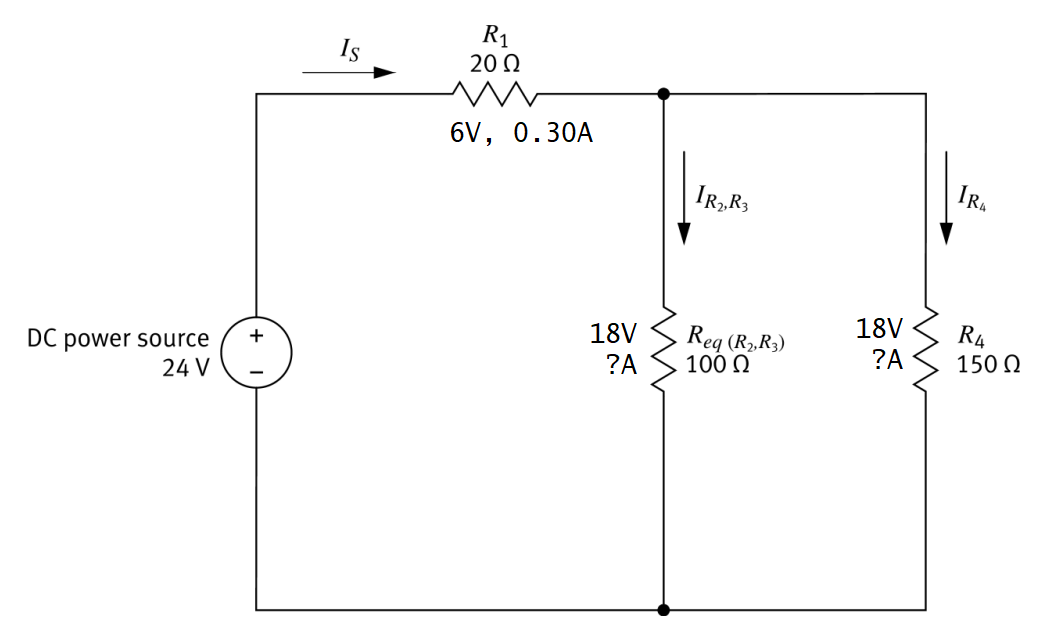
Ohm's Law
I = VR
Req(R2,R3) = 100 Ω :
IReq = ESReq
= 18100 = 0.18 A
R₄ = 150 Ω :
IR₄ = ESR₄
= 18150 = 0.12 A
KCL Check
0.18 + 0.12 = 0.30 A ✓
5
Voltage Across R₂ and R₃
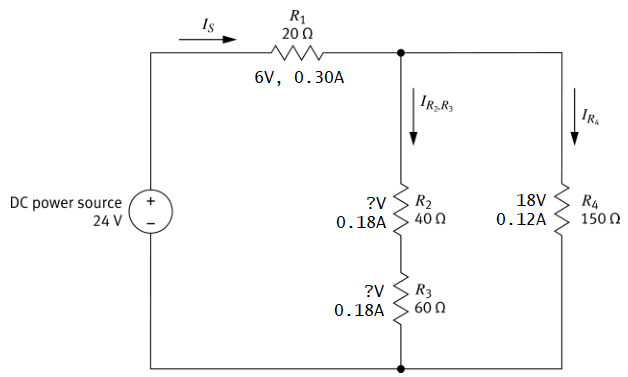
Ohm's Law
V = I × R
R₂ = 40 Ω :
ER₂ = IR₂R₃ × R₂
ER₂ = 0.18 × 40
ER₂ = 7.2 V
R₃ = 60 Ω :
ER₃ = IR₂R₃ × R₃
ER₃ = 0.18 × 60
ER₃ = 10.8 V
KVL Check
10.8 + 7.2 = 18 V ✓
Example Complete
Your Turn
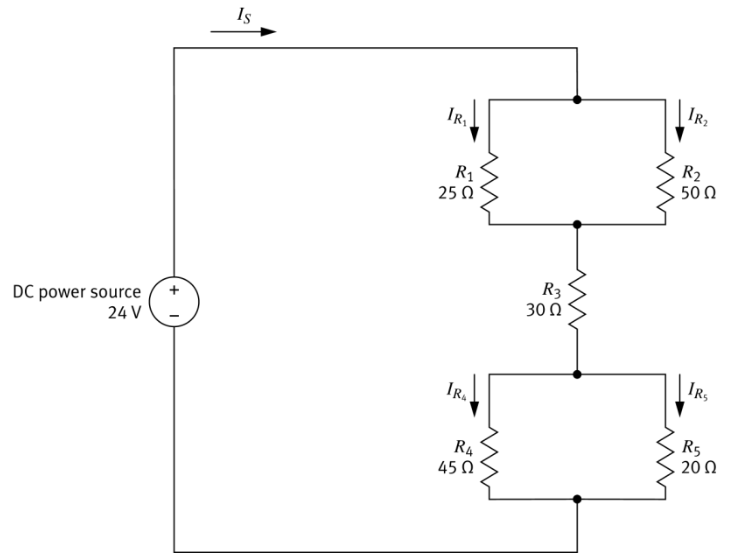
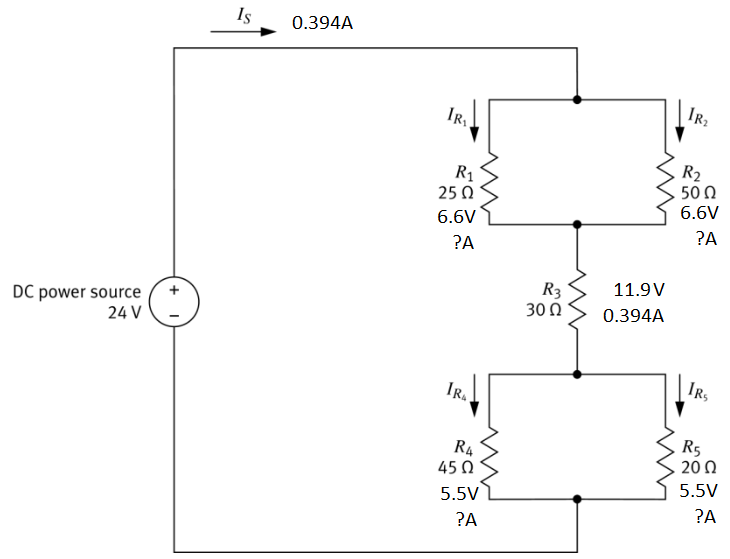
1. Simplify Parallel Resistors
(R₁ & R₂) then (R₄ & R₅)
2. Simplify the Series of Equivalent Resistors
3. Calculate the parameters at each resistor
(in reverse order)
1
Solve the Parallel Resistor Pairs
R₁ ∥ R₂
25 Ω ∥ 50 Ω
R₄ ∥ R₅
45 Ω ∥ 20 Ω
1
Parallel Formula
Reciprocal Formula
1Req = 1R₁ + 1R₂ + …
Req = 1result
1
Parallel Pairs Simplified
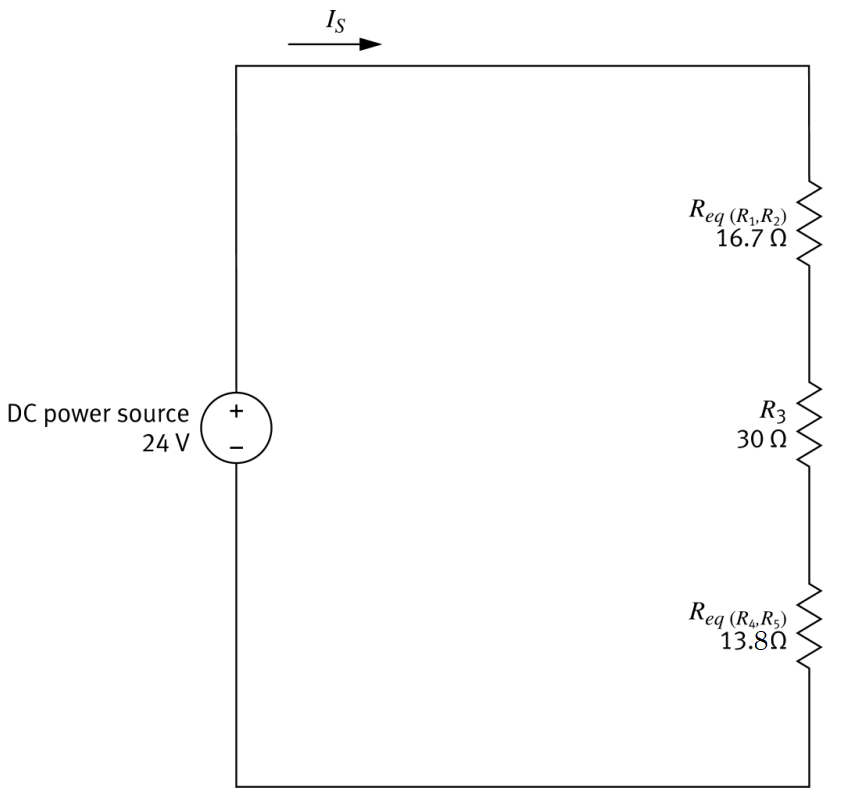
R₁ ∥ R₂
1Req = 125 + 150
1Req = 0.04 + 0.02 = 0.06
Req = 10.06
Req = 16.7 Ω
R₄ ∥ R₅
1Req = 145 + 120
1Req = 0.022 + 0.05 = 0.072
Req = 10.072
Req = 13.8 Ω
2
Simplify the Series Resistors
Req(R₁,R₂) = 16.7 Ω
R₃ = 30 Ω
Req(R₄,R₅) = 13.8 Ω
2
Series Formula
Series Formula
Req = R₁ + R₂ + R₃ + …
2
Total Equivalent Resistance
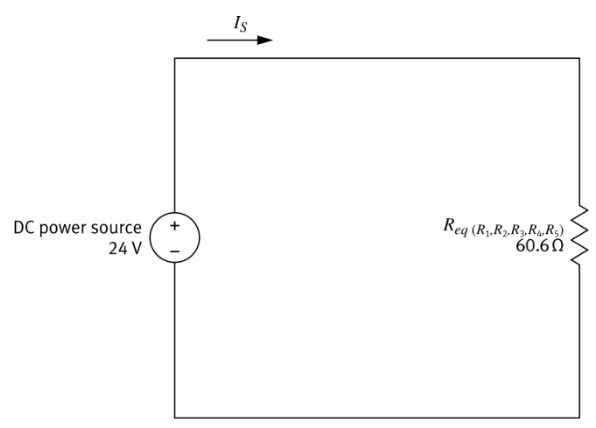
Substitution
Req = Req(R₁,R₂) + R₃ + Req(R₄,R₅)
Req = 16.7 + 30 + 13.8
Req = 60.6 Ω
3
Calculate Parameters in Reverse
Find total source current IS
Find voltage drop across each series section
Find individual currents through each parallel branch
3
Total Source Current — Formula
Ohm's Law
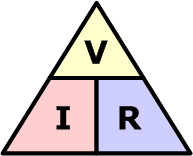
IS = VReq
3
Total Source Current — Solution
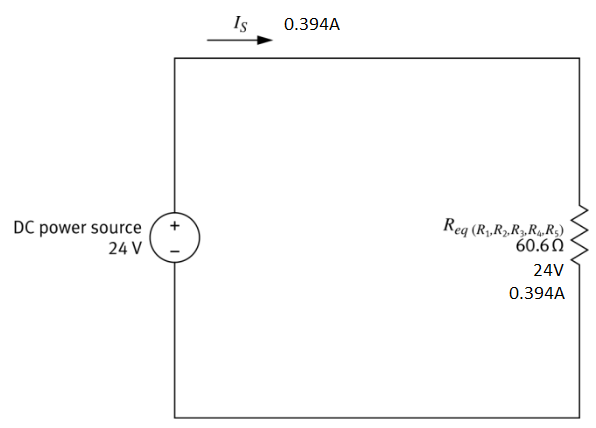
Ohm's Law
IS = VReq
Substitution
IS = VReq
IS = 24 V60.6 Ω
IS = 0.396 A
3
Section Voltages — Formula
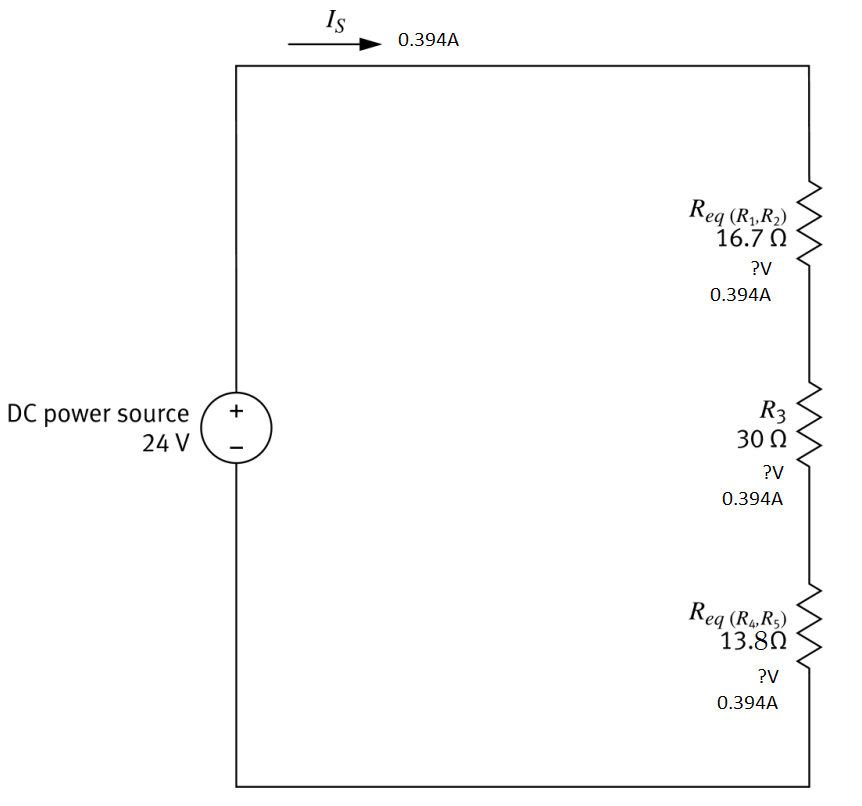
Ohm's Law
V = IS × R
3
Section Voltages — Solutions
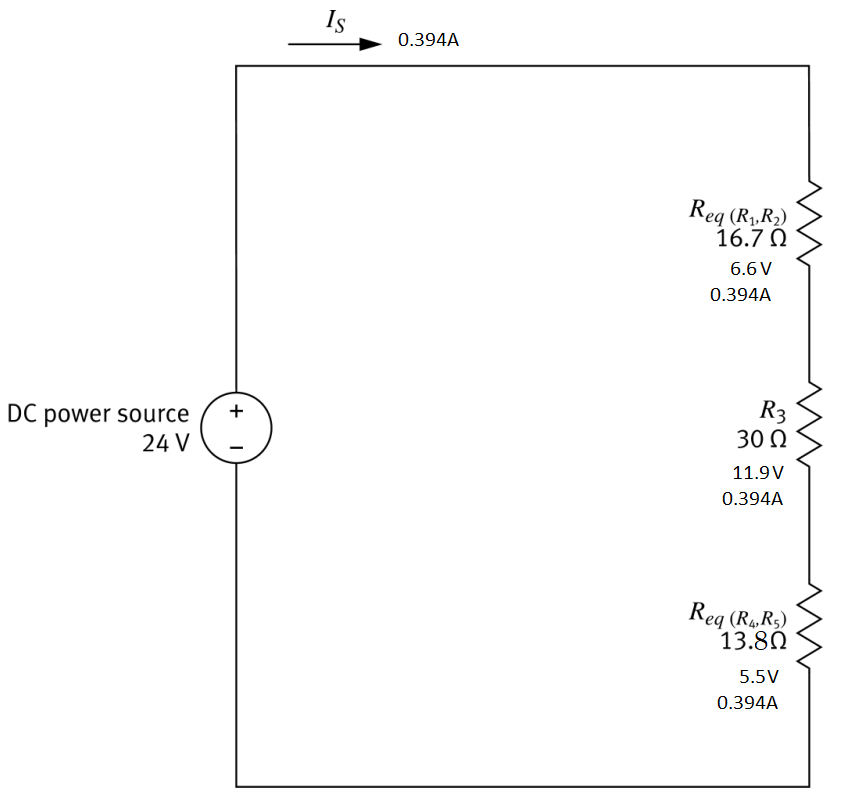
Ohm's Law
V = IS × R
VR₁,R₂
V = 0.396 × 16.7
V = 6.6 V
VR₃
V = 0.396 × 30
V = 11.9 V
VR₄,R₅
V = 0.396 × 13.8
V = 5.5 V
KVL Check
6.6 + 11.9 + 5.5 = 24 V ✓
3
Branch Currents — Formula
Ohm's Law
I = VR
3
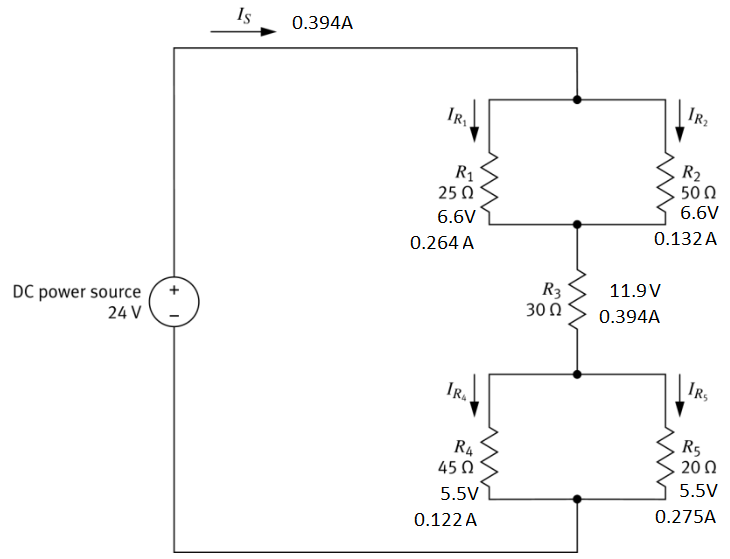
Branch Currents — Solutions
Ohm's Law
I = VR
R₁ (V = 6.6 V)
IR₁ = 6.625
IR₁ = 0.264 A
R₂ (V = 6.6 V)
IR₂ = 6.650
IR₂ = 0.132 A
R₄ (V = 5.5 V)
IR₄ = 5.545
IR₄ = 0.122 A
R₅ (V = 5.5 V)
IR₅ = 5.520
IR₅ = 0.275 A
KCL Check
R₁+R₂: 0.264 + 0.132 = 0.396 A ✓
R₄+R₅: 0.122 + 0.275 ≈ 0.396 A ✓
Example Complete